I still remember the moment when someone casually asked me a simple question What is the scientific name for a cat? At first, I smiled because it sounded easy, but then I realized I didn’t actually know the exact answer.
That moment stuck with me. I felt curious, slightly embarrassed, and genuinely interested at the same time. Instead of ignoring it, I decided to handle the situation properly.
I started researching, reading biology references, and understanding how animals are classified scientifically. Along the way, I learned not only the scientific name of a cat but also why scientific names even matter.
I discovered how these names help scientists around the world communicate clearly, without confusion caused by different languages or local names.
That small question turned into an interesting learning journey for me, and now I want to share that experience with you so you don’t face the same confusion I once did.
The Scientific Classification of Cats 🔬
Every living creature is classified scientifically to understand its place in the natural world. Cats belong to a hierarchy that includes kingdom, phylum, class, order, family, genus, and species.
- Kingdom: Animalia
- Phylum: Chordata
- Class: Mammalia
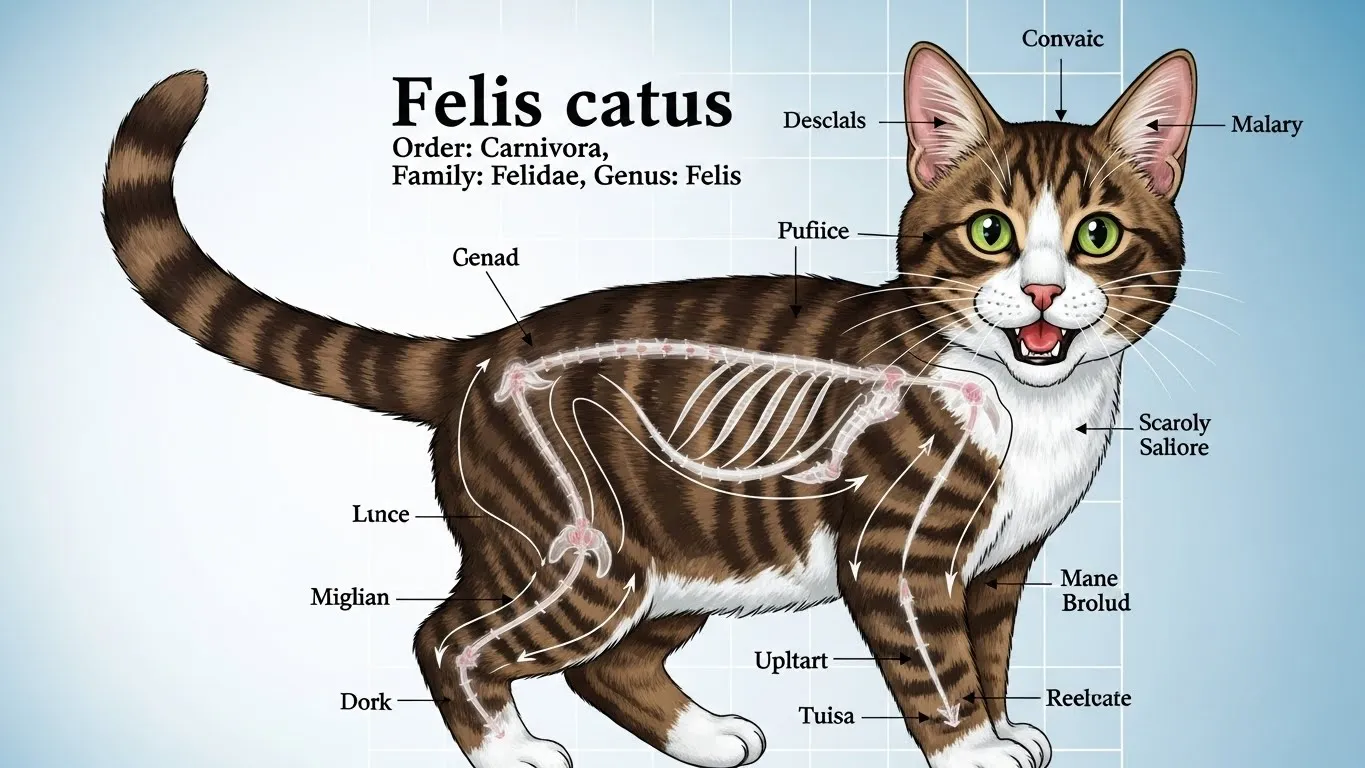
- Order: Carnivora
- Family: Felidae
- Genus: Felis
- Species: catus
This classification shows that cats are mammals, carnivores, and part of the Felidae family, which also includes lions, tigers, and other big cats.
Cat Zoological Classification
The cat zoological classification shows where cats fit in the natural world. Below is the complete animal kingdom classification of domestic cats.
Scientific Classification of Domestic Cats
- Kingdom: Animalia
- Phylum: Chordata
- Class: Mammalia
- Order: Carnivora
- Family: Felidae
- Genus: Felis
- Species: catus
This confirms that cats are mammals, carnivores, and members of the Felidae family.
Cat Taxonomy Chart and Family Tree 🌳
A cat taxonomy chart helps visualize the cat family tree and biological relationships.
- Animalia: All animals
- Mammalia: Warm-blooded animals with fur
- Carnivora: Meat-eating mammals
- Felidae: The cat family
- Felis: Small cats
- Felis catus: Domestic cats
This hierarchical structure is used in zoology and veterinary classification of cats.
Classification of Domestic Cats 🏠
The classification of domestic cats places all house cats under one species: Felis catus.
Regardless of breed—Persian, Siamese, Bengal, Maine Coon, or mixed-breed—all domestic cats belong to the same species. This scientific classification is essential in veterinary medicine and genetic research.
Difference Between Wild Cats and Domestic Cats 🐯
Many people are curious about the difference between wild cats and domestic cats.
Wild Cat vs House Cat
- Domestic cats (Felis catus):
Smaller, social, adapted to human environments - Wild cats (Panthera and other genera):
Larger, live in the wild, hunt for survival
While they share ancestry, wild cats are not domesticated and belong to different species and genera.
Feline Species List: Types of Cats in the Felidae Family
The Felidae family includes a wide feline species list, divided into big cats and small cats.
Types of Cats in Felidae Family
- Lions (Panthera leo)
- Tigers (Panthera tigris)
- Leopards
- Cheetahs
- Jaguars
- Domestic cats (Felis catus)
Despite size differences, all members share similar skeletal structures and hunting instincts.
Domestic Cat Origin and Evolution 🐾
The domestic cat origin traces back to the African wildcat.
Evolution of Domestic Cats
- Ancestor: Felis silvestris lybica
- Timeframe: Around 9,000 years ago
- Reason for domestication: Rodent control near farms
The evolution of domestic cats happened naturally, as cats benefited from living near humans and humans benefited from pest control.
Cat Genetics Research and Feline DNA 🧬
Modern cat genetics research has revealed fascinating insights:
- Domestic cats share about 95.6% of their DNA with tigers
- Coat colors, patterns, and behaviors are genetically inherited
- Many hunting instincts come from wild ancestors
These findings are essential for feline research studies, breeding programs, and disease prevention.
Veterinary Classification of Cats 🩺
In veterinary classification of cats, the scientific name Felis catus is used for:
- Medical records
- Vaccination documentation
- Disease research
- Treatment protocols
Accurate classification ensures consistent care across clinics worldwide.
Why Animal Scientific Names Matter 🌍
Understanding animal scientific names helps:
- Avoid confusion between species
- Support global scientific communication
- Improve conservation and research
For cats, Felis catus provides a universal identity recognized in every country.
Key Facts About Cat Scientific Identity 😺
- What is the scientific name of a cat? Felis catus
- Cat biological name: Felis catus
- Latin name of cat: Felis catus
- Domestic cat species: Felis catus
- Feline scientific terminology: Felis catus
No matter the language or location, the scientific identity remains the same.
Conclusion
The scientific name Felis catus is more than just a Latin label it connects domestic cats to their wild relatives, history, and biology.
From their classification to fascinating facts, understanding this name enhances our appreciation of these amazing animals.
If you’re a cat owner, student, or enthusiast, Felis catus helps you see cats in a new, scientific light. Next time you look at your furry friend, remember.
your pet carries thousands of years of evolution, science, and wonder in those whiskers and paws!

Olivia Carter is a passionate name researcher and content writer at NameMeaningg.com. She specializes in exploring the origins, meanings, and cultural stories behind names from around the world. With a clear and engaging writing style, Olivia helps readers discover beautiful and meaningful names for their children, characters, and personal inspiration.